



Astronomers Uncover Cosmic “Engine” Inside the Eye of Sauron
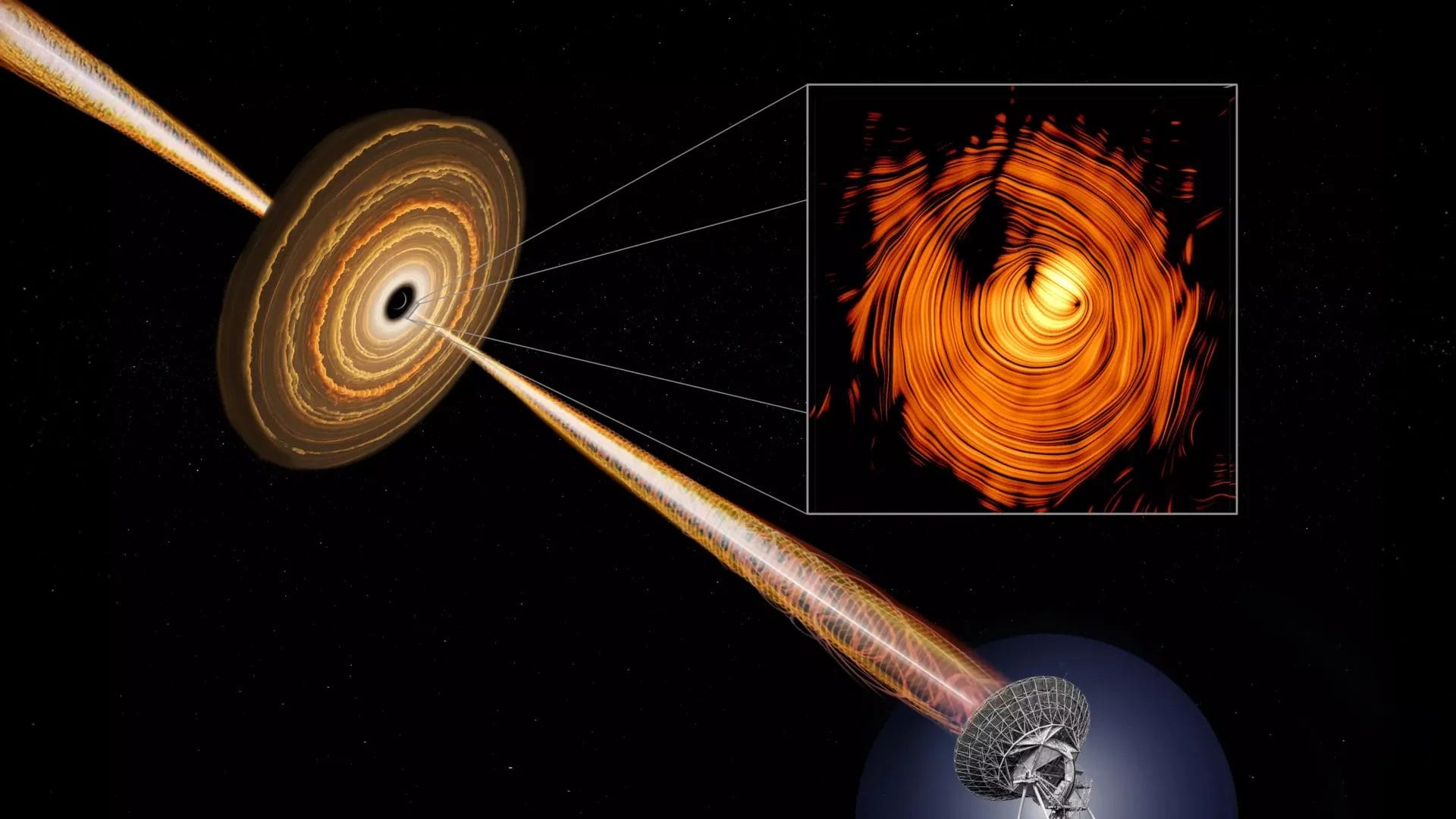
Astronomers have revealed a hidden “engine” powering the distant blazar PKS 1424+240—nicknamed the “Eye of Sauron”—thanks to 15 years of ultra-precise radio observations. Using the Very Long Baseline Array (VLBA), the team captured a stunning image showing a near-perfect toroidal (ring‑shaped) magnetic field around the jet’s throat, pointing directly at Earth Space+5ScienceDaily+5ScienceDaily+5.
Thank you for reading this post, don't forget to subscribe!
Despite its seemingly sluggish radio jet, PKS 1424+240 emits intense gamma rays and neutrinos. The solution? Its jet is aligned almost exactly toward Earth, amplifying its brightness by at least 30× through relativistic effects, while also creating an optical illusion of slow motion Space+5ScienceDaily+5Phys.org+5.
The toroidal magnetic field likely acts like a spring, accelerating particles—especially protons—to extreme energies, thereby producing the observed high-energy neutrinos and gamma rays Knowridge Science Report+5ScienceDaily+5ScienceDaily+5.
This breakthrough confirms that active galactic nuclei are not only efficient electron accelerators but also capable of energizing protons, linking them to both cosmic rays and neutrino emissions. It’s a major victory for the long-running MOJAVE program and the realm of multi-messenger astronomy Space+5ScienceDaily+5ScienceDaily+5.
Summary of Key Highlights:
-
Cosmic “Engine” Unveiled: The “Eye of Sauron” blazar harbors a toroidal magnetic field behind its jet.
-
Mystery Solved: Alignment with Earth boosts brightness and explains emissions without requiring a fast jet.
-
Particle Acceleration Insight: The magnetic structure accelerates both electrons and protons to extreme energies.
-
Milestone for Multi-Messenger Astronomy: Connects neutrinos, gamma rays, and radio imaging in one cosmic system.
This is a remarkable stride in understanding the mechanisms behind the universe’s most powerful particle accelerators.
Source: https://www.sciencedaily.com/releases/2025/08/250818102129.htm